
If you are planning a home renovation, installing kitchen cabinets, or painting a room, you have probably run into a common confusion: how to calculate running feet to square feet.
Contractors often quote prices in “square feet,” but you might have only measured the length of your walls in “running feet.” So, how do you convert between the two?
Here is the secret: You cannot convert them directly without knowing one extra number—the height (or width).
In this guide, we will explain the simple math behind converting running feet (RFT) to square feet (SQFT) so you can budget your project accurately.
Hate doing math?
Skip the manual calculations and get the exact area instantly with our free tool:
👉 Click Here to Use the Online Square Feet Calculator
What is the Difference? (Running Feet vs. Square Feet)
Before we get to the math, it is important to visualize the difference.
- Running Feet (RFT): This is a measure of length only. If you walk along the edge of a wall for 10 feet, that is 10 running feet. It is one-dimensional.
- Square Feet (SQFT): This is a measure of area. It covers the entire surface. It is two-dimensional (Length × Width).
The Problem: You cannot just turn “10 running feet” into square feet unless you know how tall or wide the object is.
The Formula: How to Calculate Running Feet to Square Feet
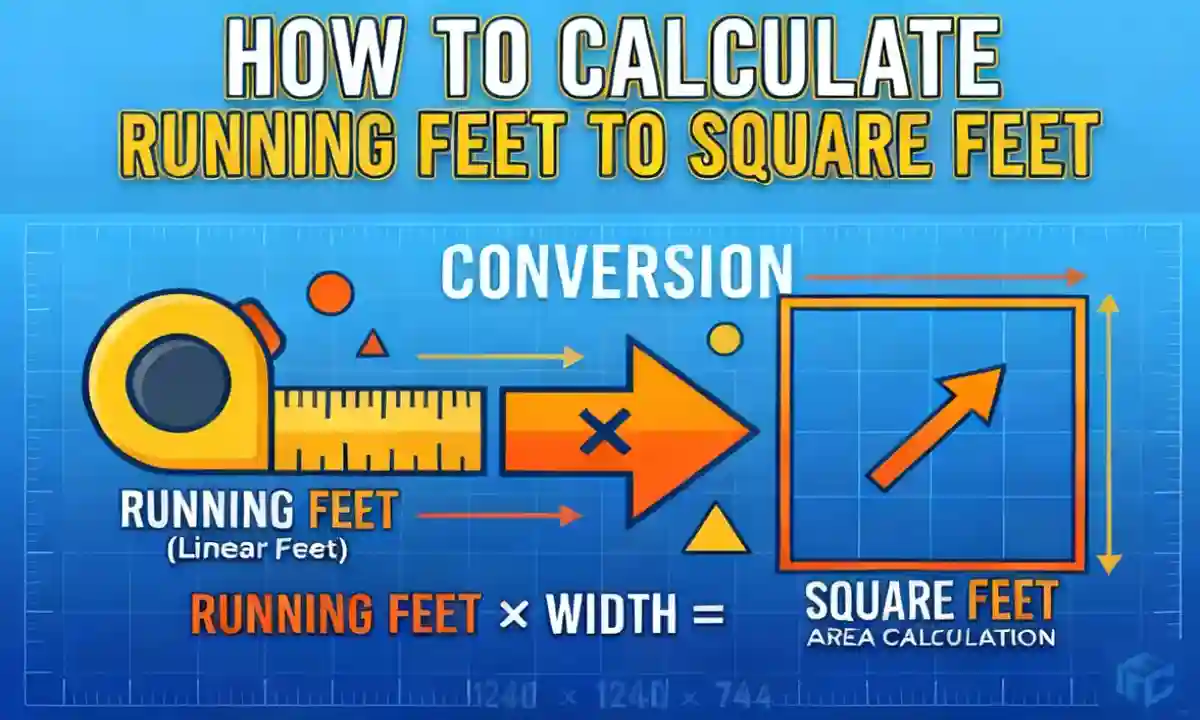
To convert running feet to square feet, you simply multiply the running feet (length) by the height or width of the area.
The Formula
Square Feet = Running Feet × Height
(Note: If you are measuring a floor or countertop, you would use Width instead of Height).
Essential Rule
Make sure both measurements are in the same unit.
- If your running feet are in feet, your height must be in feet.
- Do not multiply feet by inches!
Real-Life Examples
Let’s look at three common scenarios where you need to calculate running feet to square feet.
Example 1: Painting a Wall
Imagine you have a wall that is 15 running feet long. You need to buy paint, which is sold by the square foot coverage. The ceiling height is 10 feet.
- Running Feet (Length): 15 ft
- Height: 10 ft
- Calculation: 15 × 10 = 150
- Result: 150 Square Feet.
Example 2: Kitchen Granite Countertop
Contractors often charge for granite slabs by the square foot. You measured your kitchen counter length at 12 running feet. The standard width of a kitchen slab is usually 2 feet (24 inches).
- Running Feet (Length): 12 ft
- Width: 2 ft
- Calculation: 12 × 2 = 24
- Result: 24 Square Feet.
Example 3: Mixed Units (The Tricky Part)
What if your wall is 20 running feet long, but the height is 6 inches (like a skirting board)?
- First, convert inches to feet: 6 inches / 12 = 0.5 feet.
- Calculation: 20 × 0.5 = 10
- Result: 10 Square Feet.
Need to double-check? Don’t risk ordering too much or too little material. Enter your length and width into our Square Feet Calculator to be 100% sure.
Why Do Contractors Use Running Feet?
You might wonder, “Why don’t they just say square feet?”
In many trades—like kitchen cabinetry or compound walls—the height is standard.
- Kitchen Cabinets: Base cabinets are almost always the same height (roughly 34-36 inches). Since the height doesn’t change, contractors often quote in Running Feet to make the math faster for the customer.
However, when you buy the actual materials (like plywood, laminate, or tiles), you pay by the Square Foot. This is why knowing how to calculate running feet to square feet is crucial for checking if you are being charged a fair price.
Common Mistakes to Avoid
- Ignoring the Height: Remember, 10 running feet of a 4-foot wall is very different from 10 running feet of an 8-foot wall. The running feet are the same, but the square footage doubles!
- Multiplying Feet by Inches: This is the most common error.
- Wrong: 10 feet × 6 inches = 60 sq ft.
- Correct: 10 feet × 0.5 feet = 5 sq ft.
- Forgetting Waste: When buying materials based on your square footage calculation, always add 10-15% extra for cuts and waste.
Conclusion
Calculating running feet to square feet isn’t magic—it is just simple multiplication. As long as you remember to multiply your Running Feet (Length) by the Height, you will get the correct area every time.
Whether you are estimating the cost of a new compound wall or buying tiles for a backsplash, this simple formula will save you money and prevent ordering errors.
Ready to calculate your project area?
Use our free tool to handle the math for you instantly: